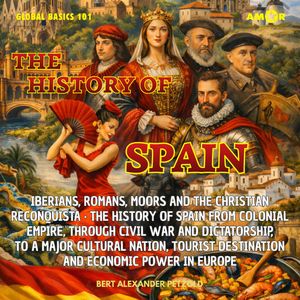
The History of Spain - Iberians, Romans, Moors and the Christian Reconquista - From Colonial Empire, through Civil War and Dicta
Autor
Sprecher
- Sprecher
- Dauer
- 4 Stunden 58 Minuten
- Verlag
- Typ
- Ungekürzt
- Format
- Hörbuch Download
- ISBN
- 9783692123684
- Sprache
- Englisch
- Kategorie
Vollversion anhören
4,99 €
Beschreibung
Why does Spain continue to fascinate as a land of conquerors, kings, artists and visionaries, and how did a medievally shaped colonial empire become a modern cultural and economic nation? This audiobook leads listeners into the very heart of Spanish history and shows why this country has shaped Europe, the Atlantic world and our understanding of culture, power and identity.
The author and editor Bert Alexander Petzold opens up a fact-rich and accessible journey through Spain's past. With a sure eye for political upheavals, social developments and cultural high points, this audiobook conveys well-founded knowledge about a country that has been one of Europe's defining forces for centuries.
The history of Spain begins with early settlement by Homo erectus, Neanderthals and Homo sapiens. With agriculture and animal husbandry, Bronze Age cultures such as El Argar, and trade between the Iberians and the Celts, the Iberian Peninsula early became a region of economic and cultural dynamism.
Phoenician trading posts and Greek colonies were followed in the sixth century BC by the rule of Carthage. From 218 BC, the Second Punic War initiated the Roman conquest and made Hispania part of the Roman world empire. After the fall of Rome, the Visigoths established a kingdom centred on Toledo, combining Roman structures with a new order.
With the Muslim conquest of 711, the era of al-Andalus began. Under the Caliphate of Córdoba in particular, it became a centre of Islamic culture, scholarship and architecture. At the same time, the Reconquista began in the north. With the capture of Toledo in 1085, the victory at Las Navas de Tolosa in 1212 and the conquest of Granada in 1492, Muslim rule on the peninsula came to an end.
Wie man ein Hörbuch hört
Hör dir das Hörbuch in der Audioteka-App auf Android- und iOS-Geräten an


Bewertungen und Rezensionen
Nur angemeldete Nutzer können Bewertungen abgeben. Jetzt anmelden
Die Meinungen stammen von angemeldeten Kunden, die unser Produkt oder unsere Dienstleistung gekauft haben. Die Meinungen werden in Übereinstimmung mit den Bewertungsrichtlinien gesammelt, überprüft und veröffentlicht.
Mehr zu dem Hörbuch
- Autor
- Sprecher
- Dauer
- 4 Stunden 58 Minuten
- Verlag
- Typ
- Ungekürzt
- Format
- Hörbuch Download
- ISBN
- 9783692123684
- Sprache
- Englisch
- Kategorie
Vollversion anhören
4,99 €