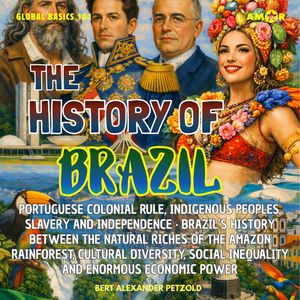
The History of Brazil - Colonial Rule, Indigenous Peoples, Slavery and Independence
Autor
Sprecher
- Sprecher
- Dauer
- 2 Stunden 21 Minuten
- Verlag
- Typ
- Ungekürzt
- Format
- Hörbuch Download
- ISBN
- 9783692123707
- Sprache
- Englisch
- Kategorie
Vollversion anhören
4,99 €
Beschreibung
How did a Portuguese colony become a country of continental scale, one that commands the worlds attention through its indigenous diversity, slavery, the Amazon rainforest and its rise as an economic power in South America? Anyone wishing to understand Brazil will discover in this audiobook far more than carnival, football and familiar clichés. "History of Brazil" opens up a fact-rich journey through time and shows, in a clear and well-structured way, how colonial rule, monarchy, republic, dictatorship and democracy gave rise to a state of international importance and global appeal.
The very beginning of this history is captivating. Long before the arrival of Europeans, indigenous cultures lived in the territory of present-day Brazil, shaping the region through their ways of life. With Pedro Álvares Cabral in 1500, Portuguese colonialism began, bringing sugar-cane cultivation, exploitation and the deportation of enslaved Africans. In the seventeenth and eighteenth centuries, gold and precious stones from Minas Gerais followed, while at the same time the cultural diversity that still distinguishes Brazil today began to take shape.
With the transfer of the Portuguese court to Rio de Janeiro in 1808, Brazil gained new significance. With independence on 7 September 1822 and the coronation of Dom Pedro I, the imperial period began. Under Dom Pedro II, Brazil experienced expansion and modernisation, but also internal tensions. The abolition of slavery by the law known as "Lei Áurea" in 1888 became a turning point. Shortly afterwards, in 1889, the monarchy came to an end and the republic was proclaimed.
Wie man ein Hörbuch hört
Hör dir das Hörbuch in der Audioteka-App auf Android- und iOS-Geräten an


Bewertungen und Rezensionen
Nur angemeldete Nutzer können Bewertungen abgeben. Jetzt anmelden
Die Meinungen stammen von angemeldeten Kunden, die unser Produkt oder unsere Dienstleistung gekauft haben. Die Meinungen werden in Übereinstimmung mit den Bewertungsrichtlinien gesammelt, überprüft und veröffentlicht.
Mehr zu dem Hörbuch
- Autor
- Sprecher
- Dauer
- 2 Stunden 21 Minuten
- Verlag
- Typ
- Ungekürzt
- Format
- Hörbuch Download
- ISBN
- 9783692123707
- Sprache
- Englisch
- Kategorie
Vollversion anhören
4,99 €